

In the last piece I argued that verifiable trust is going to be the precondition for value co-creation, and that co-creation is the operating model that will define the next era of customer experience. Now let’s go deeper into what that change is going to look like inside the enterprise.
For as long as customer experience has been a discipline, the org chart has reflected a single assumption. The customer is an endpoint. Marketing acquires them. Sales closes them. Service supports them. Product builds for them. Each function has its own metric, its own budget, and its own definition of success, and the customer moves through the org chart as a unit of work that gets handed off between functions. The journey map is just the visual layer on top of this assumption. The deeper artifact is the org chart itself.
Looking back across several waves of enterprise software, this assumption has been the structural wall every customer-centric initiative has eventually run into. The CRM era promised a unified view of the customer and tried to deliver a unified database with the same functional silos still operating around it. The customer experience suite era promised journey orchestration and delivered better tooling for the same handoff model. Each generation got closer to the customer without actually moving them out of the endpoint position, because moving the customer out of the endpoint position is not a software problem. It is an organizational design problem, and software cannot solve it from underneath alone.
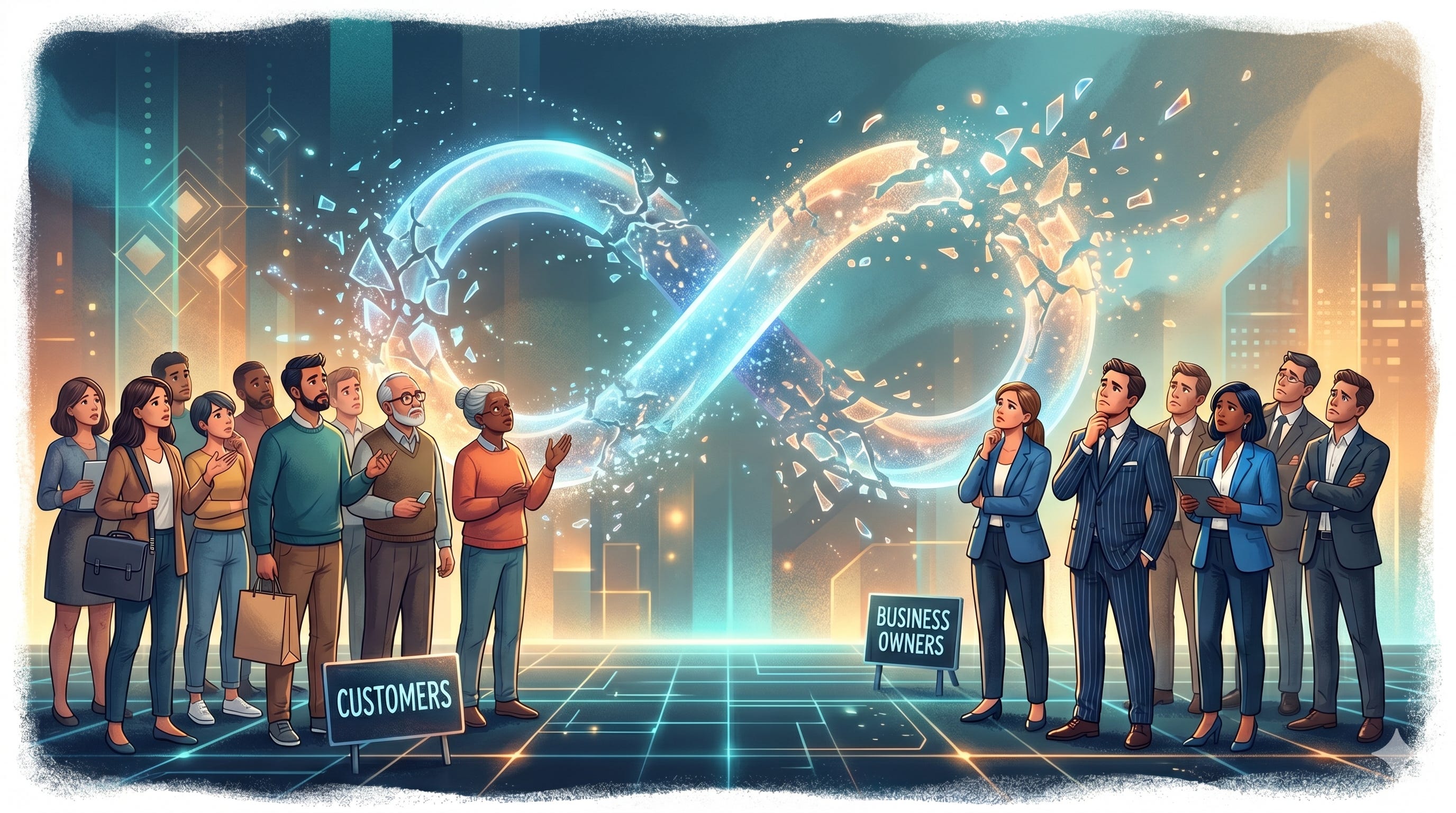
Customer-side agents are going to force the issue in a way previous waves did not. When the customer arrives at every interaction represented by an agent that holds their context, enforces their interests, and negotiates on their behalf, the enterprise can no longer treat them as the recipient of a process. The customer becomes a peer node in the relationship, and the org chart that was built to process endpoints does not know what to do with a peer node. That is the redesign question.
A few principles will define how that redesign actually unfolds.
The idea of “owning the customer” inside the enterprise is going to lose meaning. Account ownership, customer ownership, segment ownership were all artifacts of a world where the enterprise was the only side bringing structure to the relationship. When the customer brings their own agent and their own context, what the enterprise can earn is standing, not ownership. The functions that succeed in the new model will be the ones that learn to earn standing with the customer’s agent rather than insisting on ownership of a customer who is no longer asking permission to manage their own relationship.
The functional boundaries between marketing, product, sales, and service are going to soften, not because anyone decides to break them down, but because the work itself stops respecting them. When all four functions are operating against a shared context graph that includes the customer node, the handoff model that justified the boundaries becomes friction rather than structure. The functions still exist, but the question of which function owns which stage of the journey becomes the wrong question, because the journey is no longer the model.
The trust framework underneath the relationship is going to need an organizational home, and at most companies that home does not currently exist. The function that owns how customer context is received, governed, audited, and reciprocated is a function that has not been built yet at most enterprises. The principle that matters is that this function is going to be load-bearing, and treating it as a side responsibility of an existing team is going to underweight it.
Titles will evolve, because the work underneath them will evolve. Chief Customer Officer does not disappear, but the work that role does will look different when customers are no longer endpoints to be experienced and become peers to be co-created with. VP of Customer Experience does not disappear, but the experience being designed will no longer be a journey through stages. The titles will catch up to the work, the way titles always do. What the leaders in those roles do every day is what will shift first, and the language will follow.
The point I am making is that this is not just a technology tooling question alone. It is an organizational redesign question, and the redesign will run on principles long before it runs on a new org chart. The leaders who recognize that early, and start operating on the new principles before the chart catches up, will be the ones running the businesses that compound customer value through the rest of this decade. The ones who wait for the chart to change first will spend the next several years explaining why their CX investments are not returning the results that they had expected.