

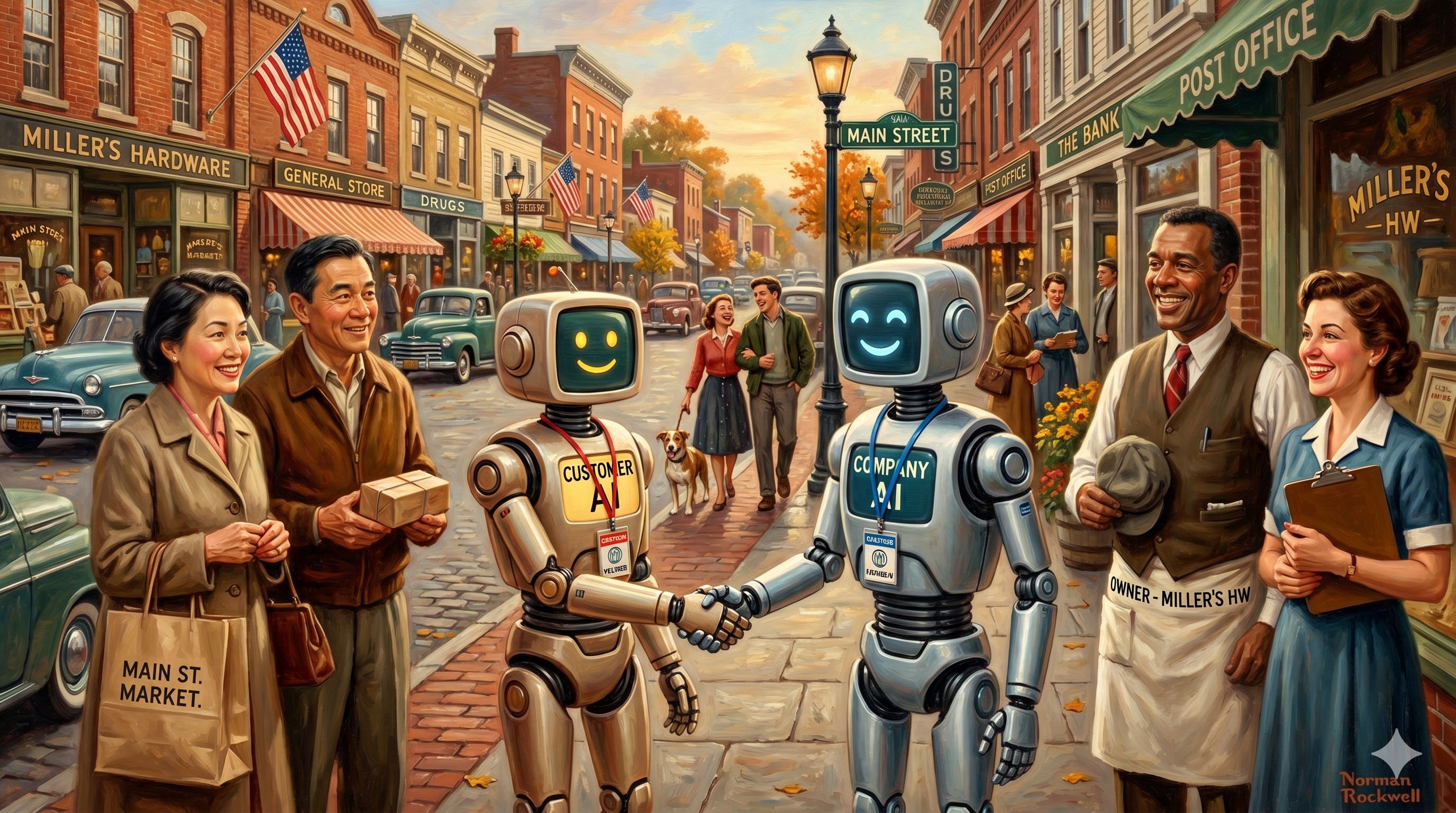
In the last piece I argued that the customer-shaped hole in the enterprise context graph can only be closed under a trust framework, something that is in active development. This piece is about what that framework is going to unlock.
Trust in the agentic era is going to be structurally different from trust in any prior era of customer experience. For thirty years it was carried by people, paperwork, and slow-moving processes. That arrangement was always more fragile than the industry liked to admit, and it is not going to survive contact with agents acting on either side at machine speed.
When a customer’s agent and a company’s agent enter a relationship, neither will be able to operate on reputation alone. The customer’s agent will have fiduciary obligations and cannot share context that might be misused. The company’s agent will have obligations to the enterprise and cannot accept context it cannot verify. The trust between them will have to be provable in real time, not assumed and reconciled later.
What is going to be needed underneath the relationship is a layer that makes three things continuously verifiable. The first is that the agents on both sides are who they claim to be and are operating within their stated boundaries. The second is that the context flowing between them is protected throughout the interaction, not just at the start and the end. The third is that everything that happened leaves a tamper-proof record either side can audit later. Attestation, enforcement, audit. Those are the foundational concepts, regardless of how the technology layer evolves to deliver them.
This matters because of what it is going to unlock, not because of how it will work. The difference between a relationship with verifiable trust and one without is not going to be incremental. It will be the difference between extracting value from customers and co-creating value with them.
A relationship without verifiable trust forces both sides to hold back. The customer holds back context because they cannot be sure how it will be used. The company holds back commitments because it cannot be sure what the customer will hold them to. Both sides operate behind narrow guardrails, which means the value that gets created is bounded by what each side is willing to risk in the absence of proof. That is the model that produced the deflection era of customer service, the consent-banner era of customer privacy, and the loyalty-program era of customer marketing. All three are different faces of the same underlying problem, which is that nobody fully trusted anybody, so nobody fully invested in the relationship.
When trust becomes verifiable, the dynamic will invert. The customer will be willing to share context that previously stayed inside their head because they can see exactly what the company can and cannot do with it. The company will be willing to commit to outcomes that previously felt too risky to promise because it can prove what was delivered. The product roadmap will improve because real usage signals can flow back in a form the enterprise can act on. Pricing will become fairer because both sides can see the value being created over time. Service will stop being a defensive function and become the connective layer where new value is generated continuously rather than reconciled occasionally.
Verifiable trust is going to be the precondition for co-creation, and co-creation is going to be the precondition for the kind of compounding customer value the deflection era never produced and never could. The leaders who win this era will be the ones who recognize, while it is still early, that trust is no longer going to be something you claim. It will be something you build, prove, and deliver, continuously, between two parties who can both verify it. The companies that start positioning for that shift now will be defining the operating model their competitors are still trying to understand. When that condition holds, value co-creation stops being a strategy deck and starts being the way the relationship actually works.