

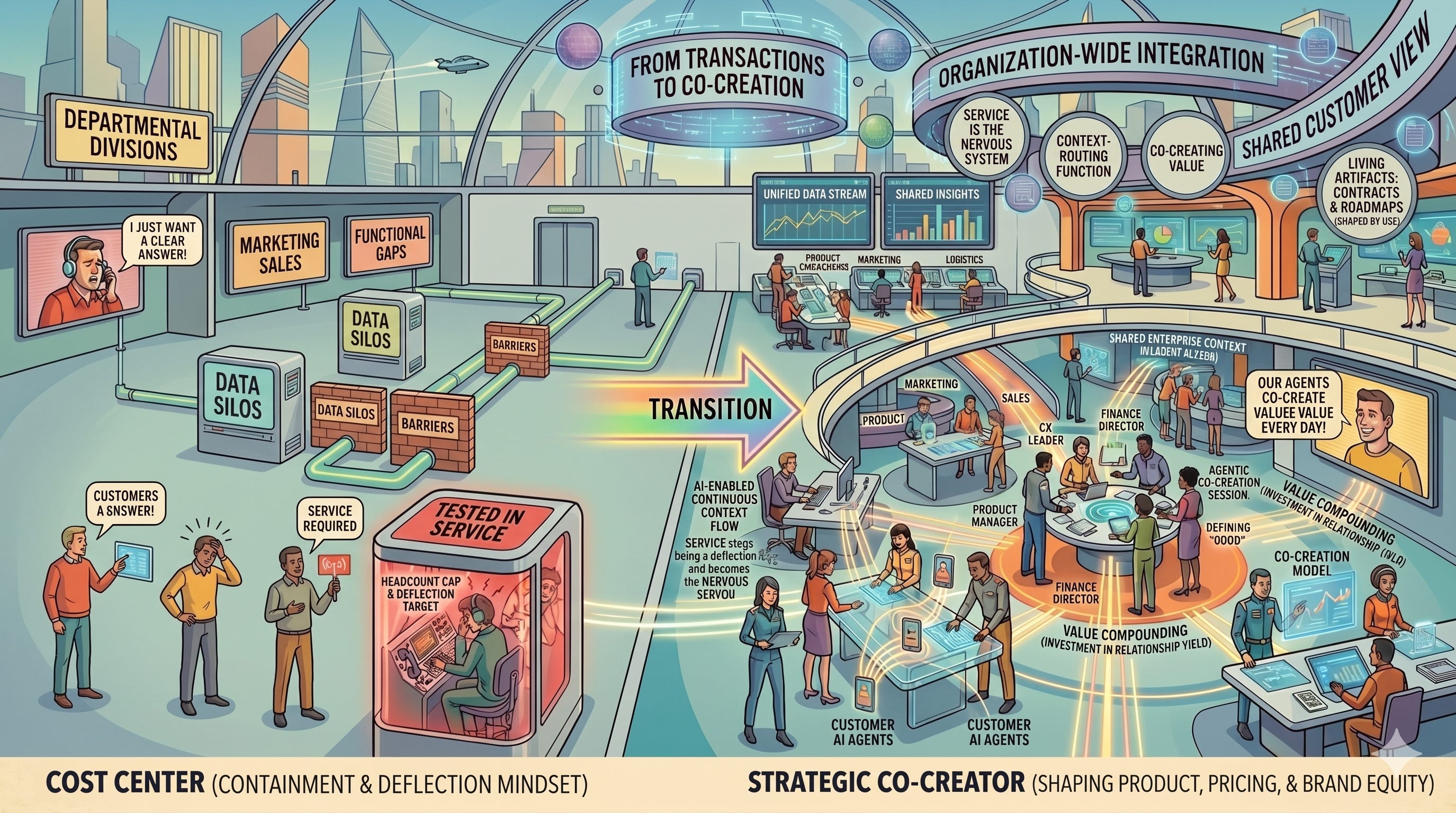
The brand promise is made in marketing, priced in sales, and tested in service. That sequence has been true for as long as customer experience has been a discipline, and yet most enterprises still invest as if the promise is fulfilled the moment the contract is signed, or product purchased. Marketing gets the budget for the promise, sales gets the comp for the close, and service gets the headcount cap and the deflection target. The part of the journey where brand value is actually proven, the long arc after the transaction where customers decide whether they got what they were sold, sits inside the function with the least strategic capital in most organizations. The math here has always been backwards, and the technology of the last thirty years gave the enterprise no real reason to fix it.
In the last piece, I argued that AI lets service stop being a translation layer absorbing the enterprise’s failures of imagination, and start operating as the nervous system of the enterprise, sensing where value is leaking and routing the signal to wherever the response actually has to come from. That reframes service from a cost center into a context-routing function. The next move is bigger. Once context is moving across the enterprise in real time, the relationship between the company and the customer changes shape entirely. Service stops being the place where oneway, company-side, value gets defended and becomes the place where value gets co-created, both company and customer benefit.
This shift is what agentic AI actually unlocks, and most CX leaders aren’t yet planning for it. The agentic conversation today is dominated by automation framing: agents that resolve tickets, agents that handle returns, agents that complete tasks without human escalation. That framing keeps service trapped inside the deflection mindset wearing a new technology coat. The more interesting move is the one the technology genuinely makes possible. When AI agents operate with full enterprise context on behalf of the customer, and when the customer’s own agents operate with full personal context on behalf of the buyer, the post-transaction relationship stops being transactional at all. It becomes continuous, bilateral, and generative. Both sides are now in a position to keep adding value to the relationship rather than periodically reconciling its failures.
That is co-creation, and it is structurally different from anything CX has been organized around before. Co-creation assumes the customer is an active participant in defining what good looks like, not a recipient of what the company decided good was at the time of sale. It assumes the product roadmap, the pricing model, the service experience, and even the contractual terms are living artifacts shaped by what the enterprise learns from how customers actually use what they bought. Agentic infrastructure makes this operationally feasible at scale for the first time. The customer’s agent can negotiate terms, surface unmet needs, flag friction, and request adjustments. The enterprise’s agents can respond with context that spans product, finance, and operations rather than the narrow script the service rep was handed in 2015.
The economic implications of this are worth sitting with. A deflection-oriented service organization extracts value from each interaction by minimizing its cost. A co-creation-oriented service organization compounds value from each interaction by feeding it back into the things the customer actually paid for. One model treats every contact as a tax on operations. The other treats every contact as an investment in the relationship’s future yield. Over a multi-year horizon those two models diverge dramatically, and the gap shows up in retention, in expansion, in pricing power, and in the kind of brand equity that no amount of marketing spend can manufacture after the fact.
This is also where the strategic positioning of CX changes inside the enterprise. For decades, service has reported into operations because the dominant frame was containment. Co-creation pulls service toward the strategic core, alongside product and finance, because the function is now generating the signal that shapes what the company sells next, how it prices it, and what it commits to. That is a different operating model, and it requires CX leaders to argue for a different seat at the table.
The promise is tested after the sale. The technology is finally good enough to honor that fact. The leaders who act on this stop investing in service as the place where the brand gets defended, and start investing in it as the place where the brand gets renewed every day the customer is still in the relationship. That is what comes after deflection, and it is the only frame that takes agentic AI seriously.