

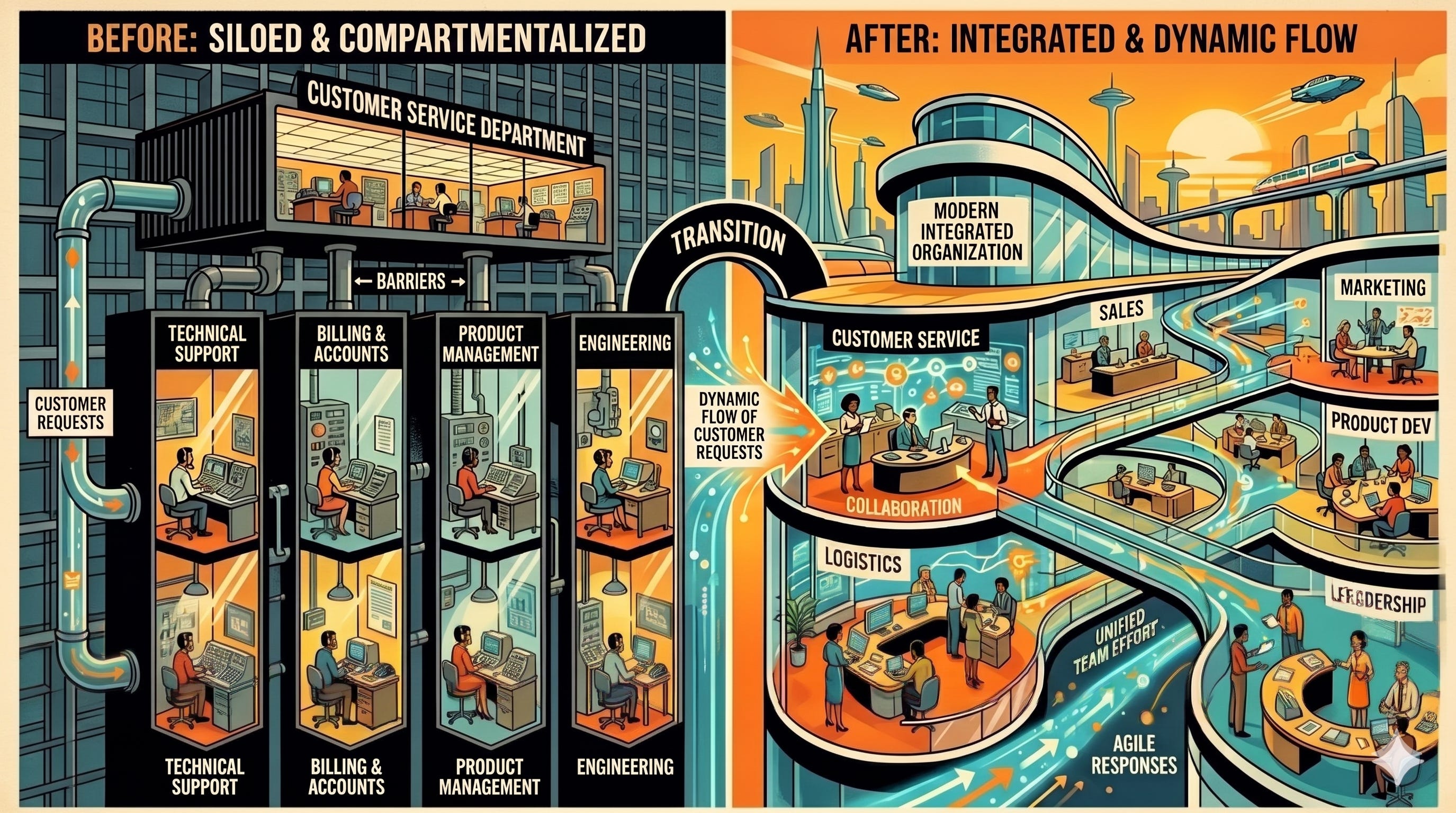
Customer service has historically been the place where the enterprise’s failures of imagination meet the customer. The product team didn’t think of that edge case. Pricing didn’t anticipate that scenario. Engineering shipped a feature that assumed the customer would think the way the org chart does. Service catches all of it, and the only reason that arrangement worked for decades is that humans inside service teams were absorbing the cost of routing context the rest of the enterprise couldn’t.
This cost is one that very few understood or priced. The reality was that customer service wasn’t a department, it was a load-bearing translation layer holding the rest of the business together. The activity got contained in a department because the technology of the time couldn’t route enterprise context any other way.
AI changes that constraint, and the strategic question for CX leaders shifts with it. The question isn’t how to deflect more contacts or close more tickets faster, it’s how to activate the entire enterprise on behalf of the customer, in real time, with the context required to actually solve the problem rather than simply deflect it.
Amdahl Comes for Value Delivery Too
In the previous piece I argued that Amdahl’s Law caps productivity gains: speed up 30% of a workflow and the other 70% defines your ceiling. The same law applies to value delivery, just with a different focus.
If your service organization can resolve a customer’s stated issue in two minutes but the underlying product gap takes six quarters to fix, your actual service excellence is bounded by your product cycle. If your agents can identify a billing pattern that predicts churn but finance can’t act on the signal for ninety days, your CX intelligence is bounded by your finance cadence. The constraint on continuous value delivery isn’t service capacity, it’s the enterprise’s capacity to absorb what service is learning.
This is why deflection metrics are a dangerous north star. They optimize a fragment of the true value journey of customers. Optimizing the part of the system that touches the customer, while the parts that produce durable value for the customer stay slow. This just produces a more efficient veneer over an unchanged business.
From Task Orientation to Process Orientation
The hard part of AI in CX isn’t getting it to handle tasks well, it’s getting it to step above tasks into the process layer where value actually moves.
Task-oriented AI answers the question, summarizes the ticket, drafts the response, and routes the case. It’s useful, and it’s where most deployments live today. Process-oriented AI does something different: it watches the patterns across thousands of customer interactions, identifies which of them encode signals that the rest of the enterprise needs, and routes those signals to the teams that can act on them. Product hears the friction pattern that’s driving 12% of contacts before it shows up in the next NPS survey. Finance sees the dispute trend before it becomes a quarterly variance. Engineering gets the product failure pattern before it lands on product review websites.
That’s the shift, and it’s harder than it sounds, because most enterprises aren’t structured to receive signals from service. Service was supposed to absorb the problem, not propagate it back upstream. Process-oriented AI breaks that thinking, and the redesign work is in deciding how the rest of the enterprise responds when it does.
The End of the Deflection Mindset
The deflection mindset treats every customer contact as a cost to minimize. The process mindset treats it as a context signal to absorb.
These two mindsets produce radically different economics over time. Deflection optimizes the existing product against the existing customer base. Learning compounds, because every interaction adds to the enterprise’s understanding of how customers actually use what they bought, what they were trying to accomplish, where the product met reality and where it didn’t.
That last piece of the puzzle is the prize. Most enterprises have detailed data on what customers buy and almost no data on the context in which they use it. AI agents that operate at the process layer, routing context across the enterprise rather than burning it inside service tickets, finally make that context legible at scale.
The CX organizations that internalize this won’t look like service organizations anymore. They’ll look like the nervous system of the enterprise, sensing where value is leaking and routing the response to wherever it actually has to come from.
That’s what the next phase looks like, and it starts the moment you stop focusing solely on deflection.