

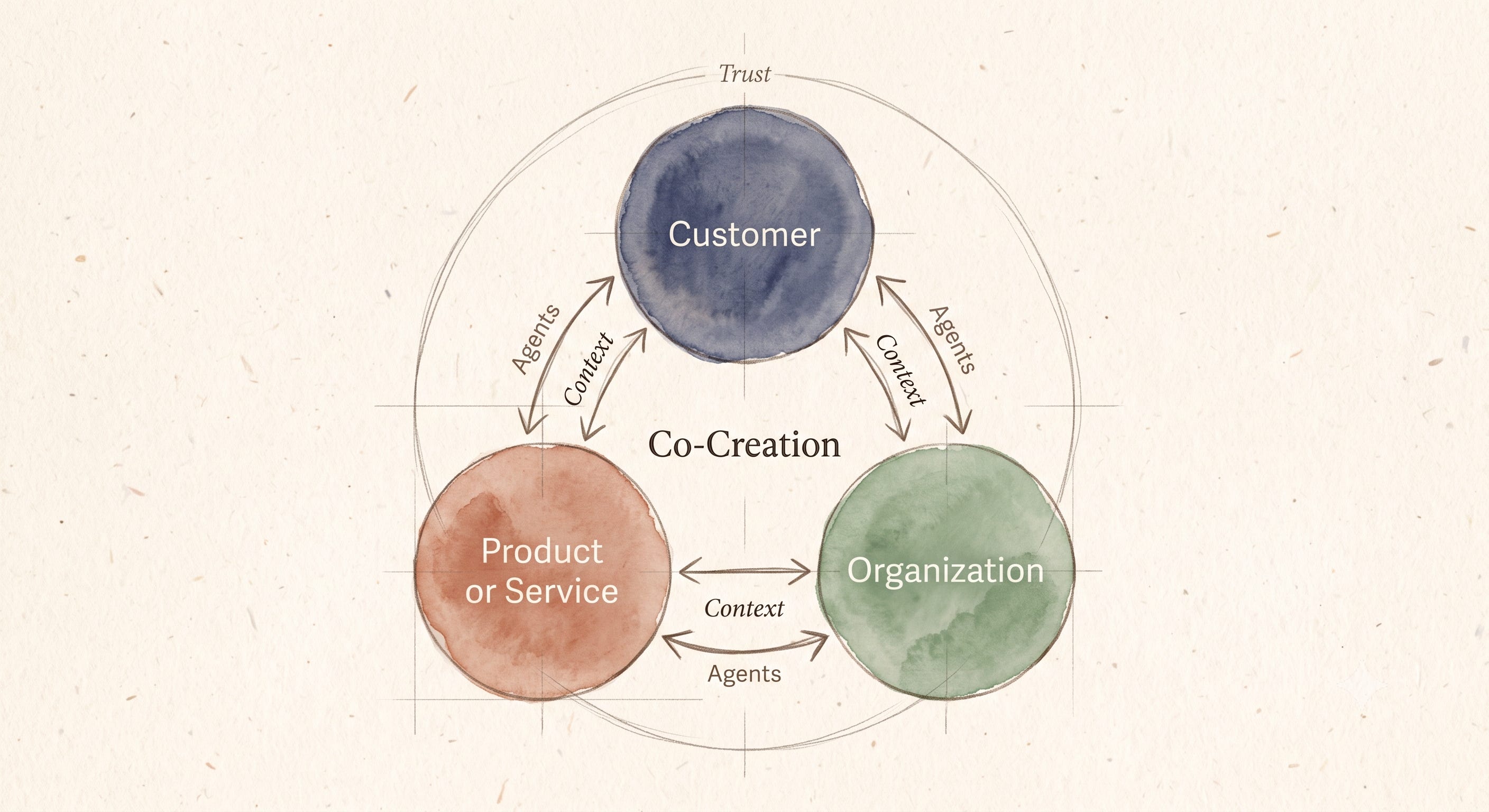
For a long time now I have been thinking about who actually knows what is going on inside a customer relationship. It’s not as straightforward a question as it seems to be. The customer operates from a context where they know what they meant to do. The company’s design parameters make it assume that it knows what it built and shipped. But neither of them, on their own, really knows what is happening in the middle, where the product/service generates value. That source knowledge sits with the product, and it is more than simple data and telemetry feeds.
The product knows how it is actually being used, not how someone hoped it would be used. It knows where users are getting stuck, which features people rely on, and which ones they ignore. When combined across multiple users, it sees patterns across everyone who touches it, which is something no individual user could ever see. If you wanted a source of truth about how a product is performing in the world, you would not go to the marketing team or the analytics dashboard. You would go to the product itself.
The trouble is that until very recently the product has had no way to tell us any of this. We have been reaching around it for years. Telemetry, session replays, support ticket analysis, voice-of-customer research. All of it useful, but none of it as good as what the product itself could say if it could talk. That is the shift I am sketching out here. Products are starting to be built with their own embedded intelligence, and that changes everything downstream of it.
Some of what I am describing has been happening in serious B2B relationships for years already. If you buy a jet engine or run a hospital MRI or operate a fleet of industrial robots, you already receive structured feedback from the product itself about how it is performing. Uptime, wear signals, performance drift. The manufacturer sees it, the customer sees it, and they operate on the same picture of what is happening. It works, and it has worked for a long time. What is new is that this pattern, which has been confined to high-stakes industrial contexts, is about to become the general case. Embedded AI is going to bring it to consumer goods, to enterprise software, to services of every kind.
When a product can speak on its own behalf, something changes about the customer-company relationship that I do not think we have fully reckoned with. The customer stops being alone with their own experience. The company stops being alone with its inferences. A third voice enters the conversation. Under a trust protocol like MyTerms, the product can share what it is seeing with both the customer’s agent and the company’s agent, on terms both sides have agreed to. Both get access to the origin source of insight for the first time.
That is what I mean when I say the product becomes a full actor in the three-body relationship I have been writing about. It is not just there to be used anymore. It has an account of what is happening, and both other actors can draw on that account directly. That is a different arrangement than the one we have been operating under for the last three decades, and I think it will produce healthier relationships for everyone involved.
There is a lot to work out. Who decides what the product pays attention to. Who it is allowed to talk to, and about what. Whether both sides can actually trust its voice, or whether it ends up quietly serving one of them. These are real design questions and we are not close to answering them. The people building the intelligence layer are mostly not thinking about the trust question, and the people thinking about trust are mostly not building at this layer yet.
What I feel certain about is that the shift is coming, and the version of customer experience we have been running for the last thirty years is not built for what happens next. For now, I would just point out that the product has been the origin source all along. It has known things about our relationships that neither customer nor company has been able to fully tap. We are about to hear from it directly. I do not think many of us are prepared for what it will have to say.