


Something has been shifting in the customer experience conversation over the last year, and most of the people having the conversation have not yet put it together. The full narrative is scattered across different discussions. Customer-side agents are being debated in privacy and consumer circles. Context graphs are being built by enterprise AI teams. Trust frameworks are being designed in standards bodies. Co-creation is being talked about as a strategy without anyone explaining how it would actually work. All of these conversations are describing different parts of the same model, which is what I’ll walk through in this piece.
The model rests on an observation that has been getting clearer as the parts have come into view. The customer is going to stop being something the enterprise does things to, and start being something the enterprise does things with. Every other shift in the conversation follows from that one.
The structure of the model is the three-body frame I introduced a while back, although I’ve shifted the definition of the tree bodies to reflect a more comprehensive operating model. The three bodies that produce durable customer value are customer, product or service, and organization. Each has its own gravity, generates its own context, and evolves on its own clock. For the entire history of customer experience, these three bodies have been navigating each other with no medium fast enough or rich enough to keep them aligned. The customer experiences a product the organization built on its best guess about what the customer would want. Each body senses the others through narrow channels, and context gets lost with every translation.
The arc of the last several months has been describing what happens when those channels widen and become structured. The change involves four different kinds of work happening between the three bodies, and each kind of work has a different character. Agents are the medium that carries the relationship. Context is the substance that flows between the bodies. Trust is the framework that governs how the substance moves. Co-creation is the result the system produces when the other three are working together.
Agents are the medium that carries the relationship between the three bodies. Customer-side agents will hold the customer’s context, enforce the customer’s interests, and negotiate on the customer’s behalf. Enterprise-side agents will hold organizational context, enforce internal policy, and act on behalf of the company. The product layer will be increasingly instrumented to emit usage signals, telemetry, and behavior data that agents on either side can act on. None of these participants will operate on reputation alone, because reputation does not survive contact with the volume and speed of agent-mediated interaction. The speed and structure of an agent-mediated relationship is different in kind from a human-mediated one, and that difference will show up at every other point in the model.
Context is the substance that flows between the bodies. Agents cannot do useful work without it. The customer-side context payload, the product telemetry, and the enterprise context graph are three sources of the same substance, and the work of the next several years is going to be making sure all three are emitting, structured, and legible to the agents that need to act on them. The companies that get this right will be operating with a much more complete picture of the customer than the deflection-era enterprise ever had access to.
Trust is the framework that governs how the substance flows. Context can only move safely between the bodies when both sides can verify what the other is doing with it. That verification has to be continuous, machine-readable, and provable in real time, because the parties involved are agents moving at machine speed. The framework has to make three things continuously verifiable: that the agents are who they claim to be and operating within their stated boundaries, that the context flowing between them is protected throughout the interaction, and that everything that happened leaves a tamper-proof record either side can audit later.
This is the area I have been watching most closely, because it is where the most important infrastructure for the entire model is being built right now. The contract side of the framework is being developed through standards like MyTerms (IEEE 7012), where the customer brings their own terms to the relationship rather than accepting whatever the vendor’s lawyers wrote. The infrastructure side is being built by companies like Opaque, whose confidential AI platform uses hardware-backed attestation, cryptographic enforcement, and tamper-proof audit logs to make trust between agents verifiable rather than assumed. The contract and the infrastructure together are what convert trust from a marketing claim into an operational guarantee.
Co-creation is the result the system produces when the other three forces are working together. The customer-company relationship stops being transactional and becomes continuous, bilateral, and generative. The customer shares context that previously stayed inside their head because they can see what the enterprise can and cannot do with it. The enterprise commits to outcomes that previously felt too risky to promise because it can prove what was delivered. The product roadmap improves because real usage signals flow back in a form the enterprise can act on. Pricing becomes fairer because both sides can see the value being created over time. Service stops being a defensive function and becomes the connective layer where new value is generated continuously rather than reconciled occasionally.
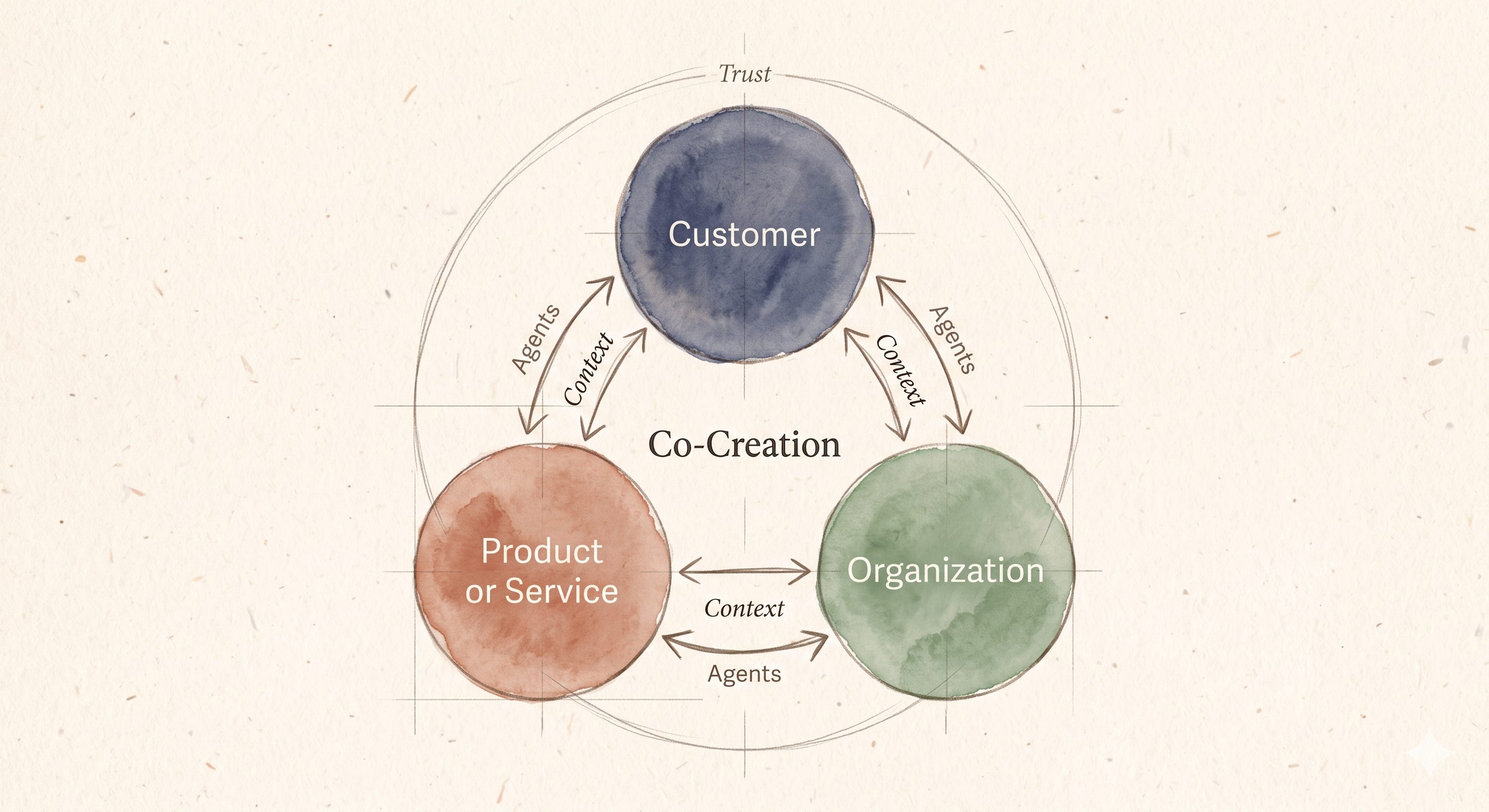
That is the shape of the model. Three bodies, four forces between them, and an operating model for customer experience that looks fundamentally different from what the deflection era produced.
The deflection era tried to run this same system without any of the forces in place. Customer-facing channels stood in for customer-side agents, siloed systems of record stood in for flowing context, consent banners and unread contracts stood in for verifiable trust, and loyalty programs and lifecycle marketing stood in for co-creation. Each of those substitutes did some of the work for a while, but the substitutes are reaching the end of what they can carry. The enterprises that try to bolt agentic AI onto a stack designed around those substitutes are going to find that the stack does not support the load.
The organizational implications are the part most CX leaders are still underestimating. The org chart was built to process customers as endpoints in a journey the enterprise designed. When the customer becomes a peer node in a relationship the enterprise no longer fully controls, the org chart starts to break down. The idea of ‘owning’ the customer loses meaning. The functional boundaries between marketing, product, sales, and service soften, because the work itself steps beyond those operational boundaries. The trust framework needs an organizational home that does not currently exist at most companies. Titles will evolve because the work underneath them will evolve.
The point of all of this is not the technology. The technology is what makes the medium possible. The point is what the medium unlocks, which is a fundamentally different economic relationship between enterprises and the customers they serve. A relationship in which both sides can invest more because both sides can verify more. One in which value is created continuously instead of extracted episodically. One in which the customer is represented in a structured way for the first time in the history of commerce, and the enterprise is held accountable in a structured way for the first time in the history of customer experience.
The shift is going to take several years to fully land. The leaders who recognize the model now and start operating on it before the org chart catches up will be the ones running the businesses that compound customer value through the rest of this decade. The ones who wait for the new model to be packaged and sold to them will spend the next several years explaining why their CX investments are not landing, and why their customers, increasingly equipped with agents the enterprise was not prepared to negotiate with, are no longer behaving the way the journey map predicted.
Customer, product, organization. Three bodies. Agents as the medium. Context as the substance. Trust as the framework. Co-creation as the result.