

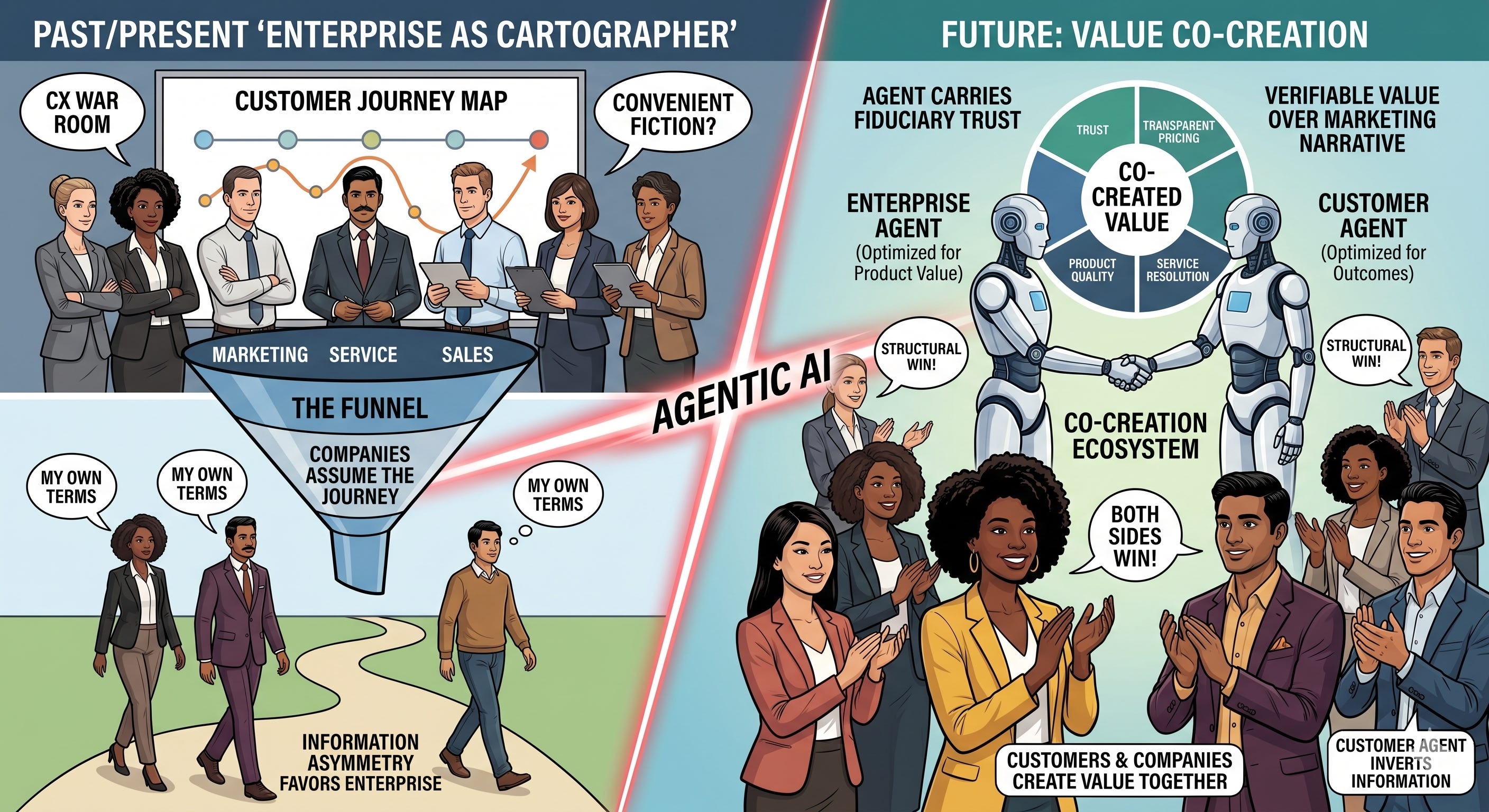
Every customer journey map I’ve ever seen drawn assumes the enterprise is the cartographer, charting a pathway for an uninformed customer. Awareness, consideration, purchase, onboarding, adoption, renewal. The stages are tidy, the arrows point in one direction, and the map gets pinned to the wall in the CX war room as if customers consult it on their way through the funnel. They don’t. They never have. I’ve come to think the journey map was always a convenient fiction the enterprise told itself so that marketing, sales, and service could coordinate handoffs across a relationship the customer was actually running on their own terms.
In the last piece, I argued that agentic AI will move CX from deflection into co-creation, where both sides keep adding value to the relationship after the sale rather than periodically reconciling its failures. That argument has a quiet assumption baked into it, and I want to pull it out into the light. Co-creation only works if the enterprise accepts that the customer is now an equal party in the relationship. Looking at the trend-line, the coming arrival of customer-side agents is what makes that shift impossible to ignore.
A customer-side agent doesn’t enter your funnel. It enters your product, your pricing page, your terms of service, your competitor’s product, your competitor’s pricing page, three independent review sources, two regulatory filings, and a Reddit thread from 2024, and it does all of that before the customer it represents has even decided whether to engage with you directly. The agent carries fiduciary trust on behalf of its principal. Its job is not to be persuaded by your marketing, it’s to optimize an outcome for the person it works for. I think that changes the structure of every interaction the enterprise has been organized to run.
The implications take a minute to settle. In a B2B context, the agent shows up to a negotiation with deeper knowledge of your product than your own sales team has, because it doesn’t have a quota to achieve and it doesn’t have a script follow. It has read your documentation more carefully than your customers ever did. In some cases, the customer’s agent has cross-referenced your SLAs against your historical incident reports. It has compared your renewal terms against the three vendors who would happily replace you. The information asymmetry that used to favor the enterprise is now inverted, and I think the inversion is central to realigning assumptions. No amount of sales enablement closes that gap, because the gap isn’t about training, it’s about whose interests the intelligence is optimized for.
The B2C version is even more interesting, because there’s no sales cycle to soften the moment of transaction. When I look at how this plays out for a consumer brand, there’s no quarterly business review, no procurement window, no relationship manager working the account. The customer’s agent just arrives, fully briefed, with a clear instruction from its principal. Find me a better mortgage. Switch my insurance if the renewal exceeds last year by more than five percent. Buy the running shoes I liked last time unless something measurably better has appeared at the same price. The brand never gets a meeting. It gets a verdict, delivered at machine speed, against criteria the customer set and the agent enforced.
That moment is where every consumer marketing assumption I’ve watched the industry build for a generation runs out of road. Loyalty programs, brand affinity, retargeting, lifecycle email, the whole apparatus was designed to influence a human who could be nudged. An agent acting on fiduciary instructions cannot be nudged. It can only be convinced by evidence its principal would value, and it will collect that evidence from sources the brand has no relationship with and no ability to shape.
This is where I think most CX strategies will break, and where the next era of value creation actually begins. The only durable response to an informed, fiduciary, agentic counterparty is to make the long-term value of what you sell genuinely defensible. Not the marketing narrative around the value, the value itself. If your product works, if your pricing is fair, if your service actually solves the problem, the customer’s agent will surface that and reinforce the relationship. If any of those things are weaker than the story you’ve been telling, the agent will surface that too, and it will route its principal toward whoever can do better.
I know this can sound threatening if you read it as the end of marketing leverage. I don’t think it is. I think marketing itself is being reshaped, and the reshape is healthier than the function’s recent decade has been. The narrative center of gravity moves from the promise of value to the delivery of value, and the leverage moves with it. The brands that win in an agent-mediated world are the ones whose marketing is grounded in what the product actually does, what the pricing actually costs over time, and what the service actually resolves. That’s still marketing. It’s just marketing that has to be true to be effective, because the customer’s agent will check.
I think this is the beginning of a much healthier economic relationship between enterprises and the customers they serve. The companies that lean into this deepen their commitment to long-term product quality, transparent pricing, and service that compounds value over time. Marketing becomes the function that translates real value into language the customer’s agent can verify, rather than the function that manufactures preference in the absence of verification. The customers who deploy agents on their behalf get representation in a relationship where they have historically been outgunned. Both sides win, and the win is structural rather than promotional.
The journey map was the enterprise’s fantasy of control. The customer-side agent is the customer’s restoration of a durable balance in the relationship. The leaders who internalize that shift early will build the businesses that are still standing when the dust settles, and they will do it by competing on the only thing that survives an agent-mediated relationship, which is whether what you sell is actually worth what you charge for it.