

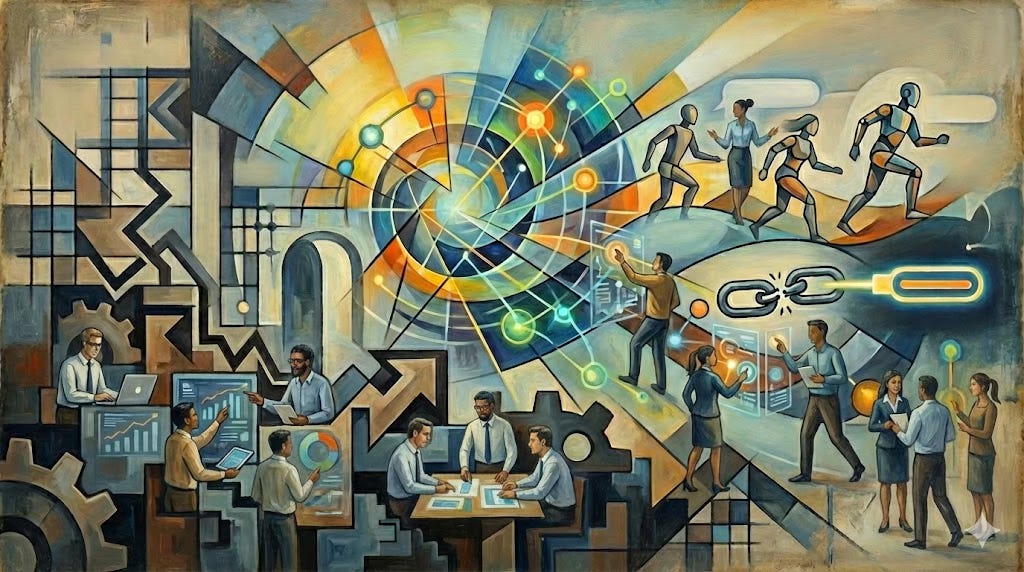
In my last article, I made the case for why individuals need personal AI agents that operate with machine-readable contracts like IEEE 7012 (MyTerms) to reclaim control in digital relationships. When customers’ agents can automatically negotiate terms and route around services that don’t respect those terms, the power dynamic fundamentally shifts. Now let’s dig deeper into what happens to the businesses on the other side of those relationships.
The Callable Function Model Is Breaking
I also recently wrote about how many organizations risk reducing their human employees to just “callable functions.” This model implies that humans are simply API endpoints that AI could invoke when it needed something, get a response, then move on without context, without deeper learning, and simply treat the humans as transactional actors in a AI-driven process. If AI-driven processes scale too quickly, we may end up treating customers the same way, as customer interactions reduced to objects to be processed, without much context or insight.
We, the customer, often feel this way already. Marketing automation “calls” us with targeted messages. Data systems “invoke” us for information. Many CRM/CX operations and systems architecture assume customers are stateless endpoints in their processing pipeline. We intuitively know that’s an unfair, and unfortunate reality. But, what happens when customers get their own AI Agents?
The Shifting Power Dynamic
If customers control all their own data through AI agents operating under their terms, how does the established dynamic shift?
Traditional CX platforms create value through data aggregation. Collect customer data, build unified profiles, generate insights, ultimately, to drive revenue. But when customers’ personal AI agents carry their own complete data profiles and can reject terms that don’t respect customer privacy, that entire value proposition evaporates. Just like treating workers as callable functions undervalues expertise, treating customers as data endpoints undervalues the relationships that create sustainable business outcomes.
From Data Landlord to Service Provider
As customer-side AI agents enter the CX ecosystem, a fundamental pivot is required from owning customer data to optimizing how we interact with customers who control their own data.
In the AI agent-driven economy, competitive advantage will likely shift to speed of agent response, quality of interactions, reliability of commitments, and sophistication of services. It’ll require a mindset shift from being a data landlord to being a service provider. More fundamentally, it’ll move from treating customers as callable functions in your workflow to recognizing them as platforms that have sophisticated interests that have greater context, and recognizing that customers, too, actively run their own workflows and processes.
The MyTerms Inversion
This is what Doc Searls and the VRM (Vendor Relationship Management) community have been championing for nearly two decades. It’s a future where customers regain a balance of power and become the center of their own relationship networks rather than objects in vendor CRM systems.
Personal AI will make this practical at scale. While company CRM systems will continue to be critical for success to orchestrate customer-centric value co-creation, customers controlling their own data will begin the process of rebalancing customer experience dynamics. When customers stop being callable functions, and have their own platforms, greater opportunities for value co-creation will appear.
The surveillance-based model never delivered on the promise of great CX—it just made vendors better at manufacturing consent and treating customers as data objects to manipulate. An emerging agent-driven model, built on bilateral contracts and customer sovereignty, might actually deliver on that promise.
The companies that stop treating customers as callable functions and start treating them as platforms with their own agency won’t just survive the transition. They’ll thrive in ways the current vendor-controlled model never allowed.