

Looking back at 2025, one concerning pattern I’ve observed is, in the race to ‘deploy’ AI, organizations are inadvertently reducing humans to the status of API endpoints. So many of the AI pitches today put AI in the driver’s seat. So, when an AI agent hits an edge case or needs approval, it “calls” the human, much like a piece of code invokes a function, gets a response, and moves on.
Realistically, especially this early in mass AI adoption, this cannot became the dominant architecture. And heading into 2026, it’s a problem we can’t afford to ignore.
The callable-function model treats human workers as components in a processing pipeline rather than contributors of unique value. Humans became stateless services that are invoked when needed, then released. No context carried forward. No learning exchanged. Just transactional handoffs disguised as collaboration.
The risks of this approach accumulate slowly, but dangerously. Customer Experience operations that architect systems this way systematically underutilize the very capabilities that differentiate exceptional customer experiences from others. This approach undermines human contextual judgment, creative problem-solving, and the ability to read between the lines of what customers actually need versus what they’re saying.
2025 was the testing ground to embed AI into a smattering of processes and subprocesses, with the hope to find scale. It was also the year, hopefully, that exposed that we often automated the wrong things.
The Expertise-as-Overhead Trap
This year’s narrative often positioned AI as doing the “real work” while humans cleaned up exceptions. That framing led too many organizations down a path that’s already showing cracks.
Consider what happens with specialized agents like those with deep domain knowledge in financial services, healthcare, or complex B2B relationships. They bring something AI can’t replicate: the ability to synthesize incomplete information, recognize emotional subtext, and make judgment calls that no training data can anticipate. Yet many of these specialists were sidelined or reduced to escalation handlers.
The question for 2026: What happens when we stop treating this expertise as overhead and start designing AI to amplify it instead?
Strategic Talent Allocation Becomes Non-Negotiable
One lesson that crystallized over the past twelve months is that treating both human and AI agents as resources with distinct skills, capacity constraints, and costs isn’t optional anymore. The organizations that figured this out gained real advantage. Those that didn’t found themselves burning through talent while their AI initiatives remain somewhere out in the Wild West with no clear benefit, value, or outcome.
A logical path going forward is where success will require deploying human agents where context and critical thinking create disproportionate value. These use-cases include complex escalations, relationship-critical moments, situations where getting it wrong carries real consequences. AI will handle scalable data production and routine inquiries where consistency and speed matter most.
Human effort was never a cost to minimize. Hopefully, in 2026 we start treating it as the strategic asset it always was.
Co-Agency Moves from Concept to Imperative
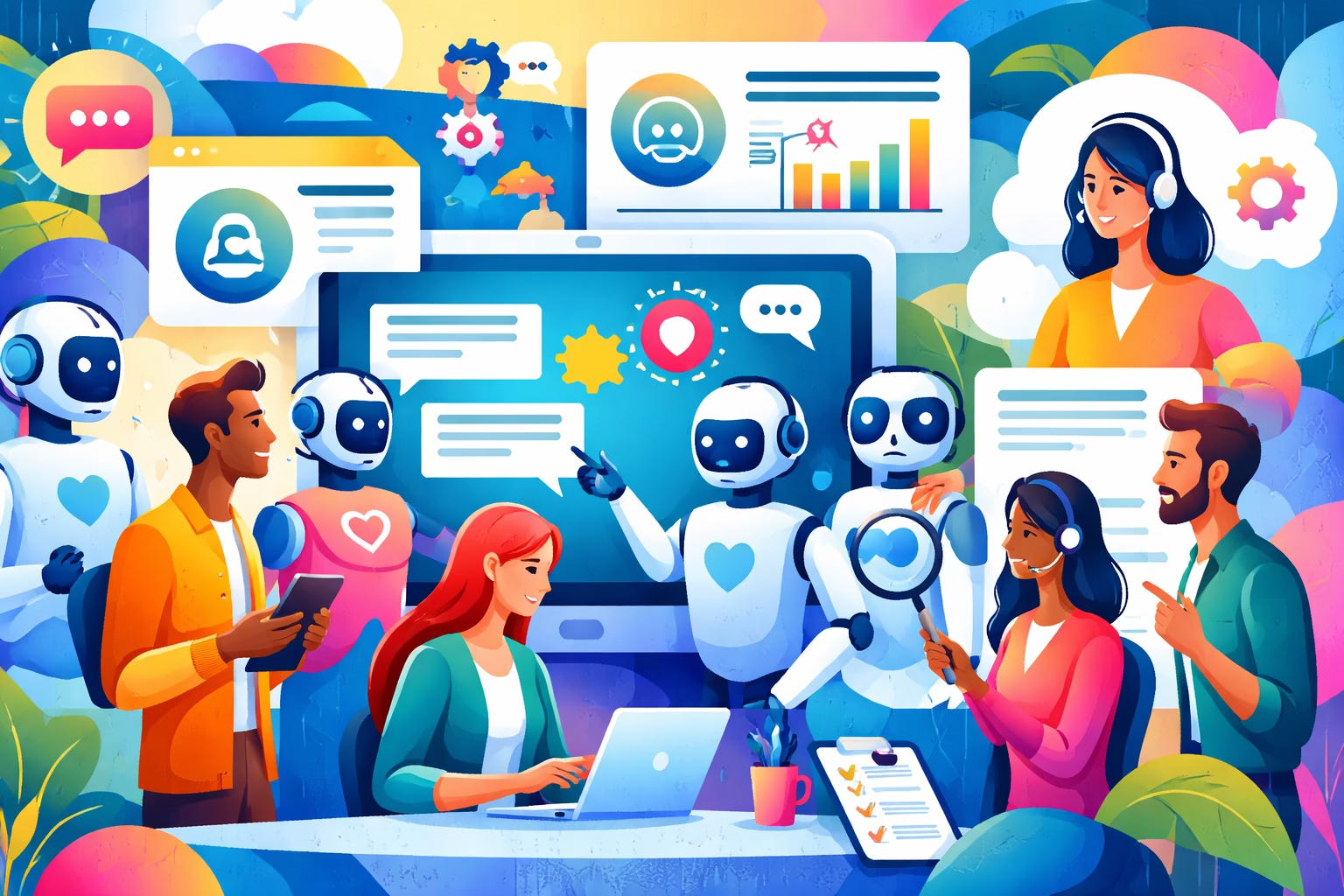
The most promising developments of 2025 came from organizations experimenting with genuine co-agency where AI and human agents were solving problems together rather than passing tickets back and forth.
In these models, AI assists in breaking down complex issues, validates potential solutions, and surfaces relevant information in real-time. Human agents provide critical judgment, emotional intelligence, and creative problem-solving. Neither is the fallback; both contribute throughout the interaction. The AI learns from human judgment patterns while humans gain insights from AI’s pattern recognition.
The early adopters are proving variations of this model works. Now the rest of the market has to catch up, or fall behind.
Ground Truth Isn’t Optional
Every model predicting customer needs or personalizing recommendations depends on accurate data, and the only reliable way to validate that data is through human ground truth. Organizations that treated human feedback as optional discovered their AI systems drifting toward bias and degraded performance.
We need build human ground truth into the architecture from the start, not as an afterthought.
The Opportunity Ahead
2026 opens with a rare moment of clarity. The AI hype cycle is in overdrive, but there is also ground-based reality of what the human-AI collaboration should look like. The real opportunity will come from identifying those instances where human knowledge, intuition, and judgement provide the greatest value and model AI frameworks accordingly. Organizations that answer this thoughtfully will discover something powerful. When AI and human expertise truly combine, they unlock insights neither could achieve alone. AI identifies patterns across millions of interactions. Humans interpret those patterns through business context and customer psychology.
That’s the real prize waiting in 2026, but only for those who understood that humans were never meant to be callable functions in someone else’s workflow.