

The question that came out of Salesforce’s TrailblazerDX last week would have been unthinkable three years ago: “Why should you ever log into Salesforce again? Maybe you never will.”
It’s worth pausing on where that question is coming from, and what the company asking it has been right about before.
Salesforce practically invented the on-demand CRM category in 1999, when the enterprise software consensus was that anything critical had to run on-premises. They were early on the mobile enterprise wave. They moved into platform-as-a-service before most of their competitors understood what that meant. Each of those moves looked aggressive at the time and obvious in hindsight. Marc Benioff has a specific talent for arriving at the destination before his customers know they’re going there, then making the road himself. That history is the right frame for evaluating Headless 360, because dismissing it as a defensive pivot misses the pattern.
That said, being early and being right are different things, and the gap between them is where the risk lives.
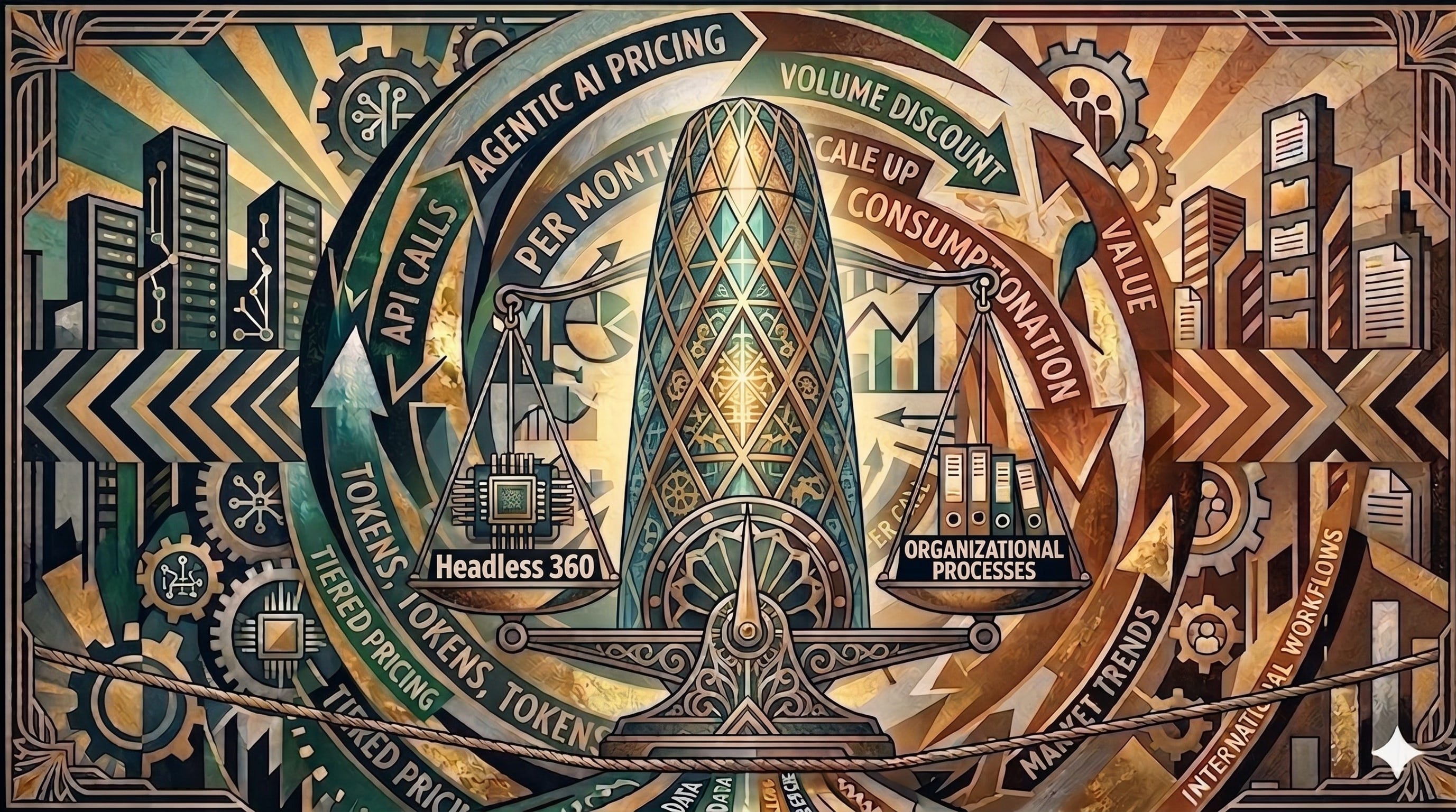
Three weeks ago, I wrote about how the per-seat model collapsed because it measured logins instead of value. AI agents do real work that the usual measures have no way to account for. If users stop logging in, the seat stops being a useful unit of anything. Headless 360 is Salesforce’s architectural answer to that problem: expose the entire platform so that AI agents can operate it without a human in the loop. Benioff’s framing was direct: “No Browser Required. Our API is the UI.” He recognized that the value question was never about the browser as the UI, and associated seat based pricing, it was always about where value gets delivered, and who or what is doing the delivering.
The margin problem hasn’t gone away, and Headless 360 doesn’t resolve it. Traditional software margins were built on a simple structural reality: write the code once, sell it infinitely, and the cost of serving the next customer is nearly zero. AI breaks that. Every agent interaction burns real compute. Every workflow execution carries a cost that doesn’t disappear with scale. Salesforce’s stock is down roughly 28% year-to-date partly because the market is repricing what software economics look like when the product has to do actual work on every transaction.
The pricing picture is where my most recent piece on the open questions in every AI contract connects most directly. What Salesforce has not fully disclosed is the price of the Headless 360 infrastructure that sits underneath their current Agentforce initiative. Currently, it ships bundled with existing platform licenses. That sounds straightforward until you read Salesforce’s history of introducing capabilities in a base tier, letting customers build dependencies on them, and separating them into a premium tier later. It’s a playbook they’ve run before, and it has worked. SaaStr’s Jason Lemkin captured the logic clearly: when agents are doing the work, the CRM isn’t a filing cabinet anymore. It’s the brain. Switching costs go up, not down. That’s a genuine competitive advantage. It also describes exactly the kind of architectural dependency that makes future pricing conversations harder for buyers.
Info-Tech analyst Scott Bickley put it plainly: “CIOs should be asking about pricing now, before building in architectural dependencies on features that might land in a premium cost tier.”
Salesforce has earned the benefit of the doubt on bold architectural bets. They’re asking for it again here, on a bigger bet, in a market where the pricing rules are still being written. The architecture for the agentic world is still settling, but Salesforce’s directionally right. Whether the economics work for buyers at the scale Salesforce is projecting is the question nobody on either side of the table can fully answer yet.
The incumbent is taking another swing at setting the market standard. It’ll be interesting to see where this goes.