

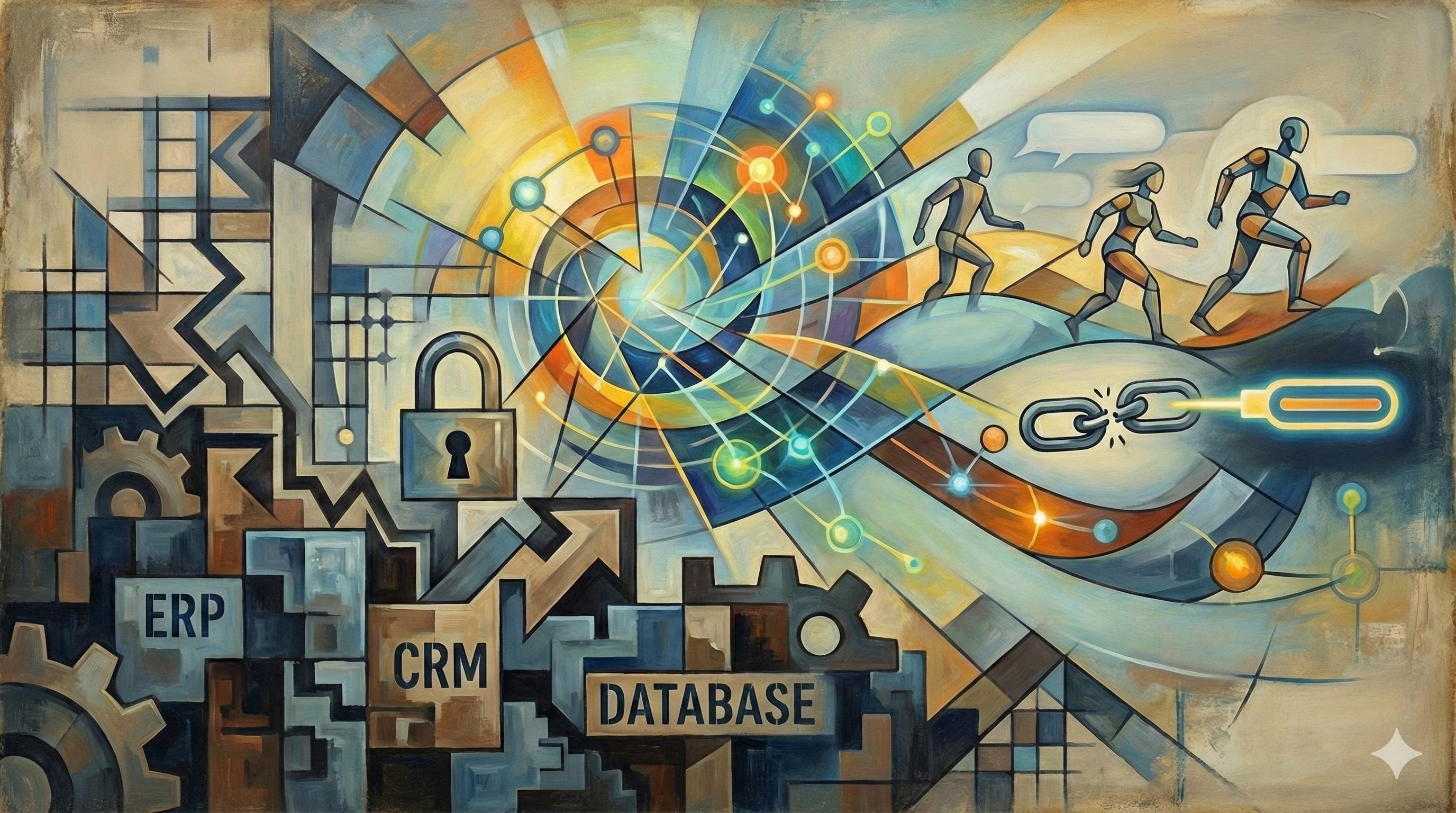
We’ve all had that moment. You want to make a simple, or strategic, change to your processes, like tweaking a customer journey, and you hit a wall. While the business expects to be dynamic, it’s now IT where the bottleneck appears, “We can’t touch those systems right now. Your changes will require us change hard-coded logic that is deep in the database schema. Check back in Q3.”
It’s frustrating, but whose fault is it? For years, we’ve built companies on a bit of a flawed premise that our Systems of Record (our ERPs, CRMs, and databases) were the place where our business logic should live. We took our dynamic, breathing strategy and locked it into static, rigid code. As I wrote a few weeks back, the most profound impact of Agentic AI will be in extracting this logic upwards to a dynamic orchestration layer, something that Forrester Research calls Systems of Agency. This orchestration layer will take years to stabilize, but the core will be a shift from writing rigid rules based logic to goal oriented guidance, largely for agentic AI guide-rails.
AI agents won’t blindly follow a script, they’ll use reasoning, context, and navigate through paths which are not all established. While there will be risks, there are a couple of clear benefits of this evolution:
Killing the “Toggle Tax”: Much of ‘work’ for human employees today requires constant context switching, from one interface to another, and back. The ‘toggle tax,’ or I often call it integration at the keyboard level, makes work wildly inefficient and is a productivity killer. Also lost in this process is the actual, underlying knowledge that is created while shoving data between poorly integrated processes.
The “USB-C” for Enterprise: While not a perfect comparison, as USB-C itself has all kinds of complexity, having standards like Model Context Protocol (MCP) will begin to move disparate enterprise process flows away from proprietary APIs toward a more standard approach. The standardization will enable business logic to move out of database architectures, and into a more dynamic orchestration layer.
And that’s just the beginning. This long road ahead isn’t about replacing people, rather freeing them up to expand their value and creativity. Enough of the toggle tax already. The future of the enterprise isn’t about better applications or databases. It’s about smarter orchestration. And honestly? It’s about time.