

For most of the last century, brand has been the organizing concept of marketing. Every mature marketing organization is built around the idea that the enterprise controls what it stands for and how customers come to understand that. The channels, the timing, the language. All of it has been the enterprise’s call. That control is going away, and the version of brand coming to replace it does not fit neatly inside the marketing conversation we have been having for a hundred years.
Brand has always sat in the space where three things collide. The claims the enterprise makes about itself. The customer’s actual experience of what they bought. The product’s real behavior once it is out in the world. The problem is that these three things have never really been in conversation with each other. The enterprise made its claims. The product either held up or it did not. The customer formed impressions somewhere in the middle, and shared some of them with friends. It has been slow, it has been indirect, and only one side of the exchange has ever had structured leverage.
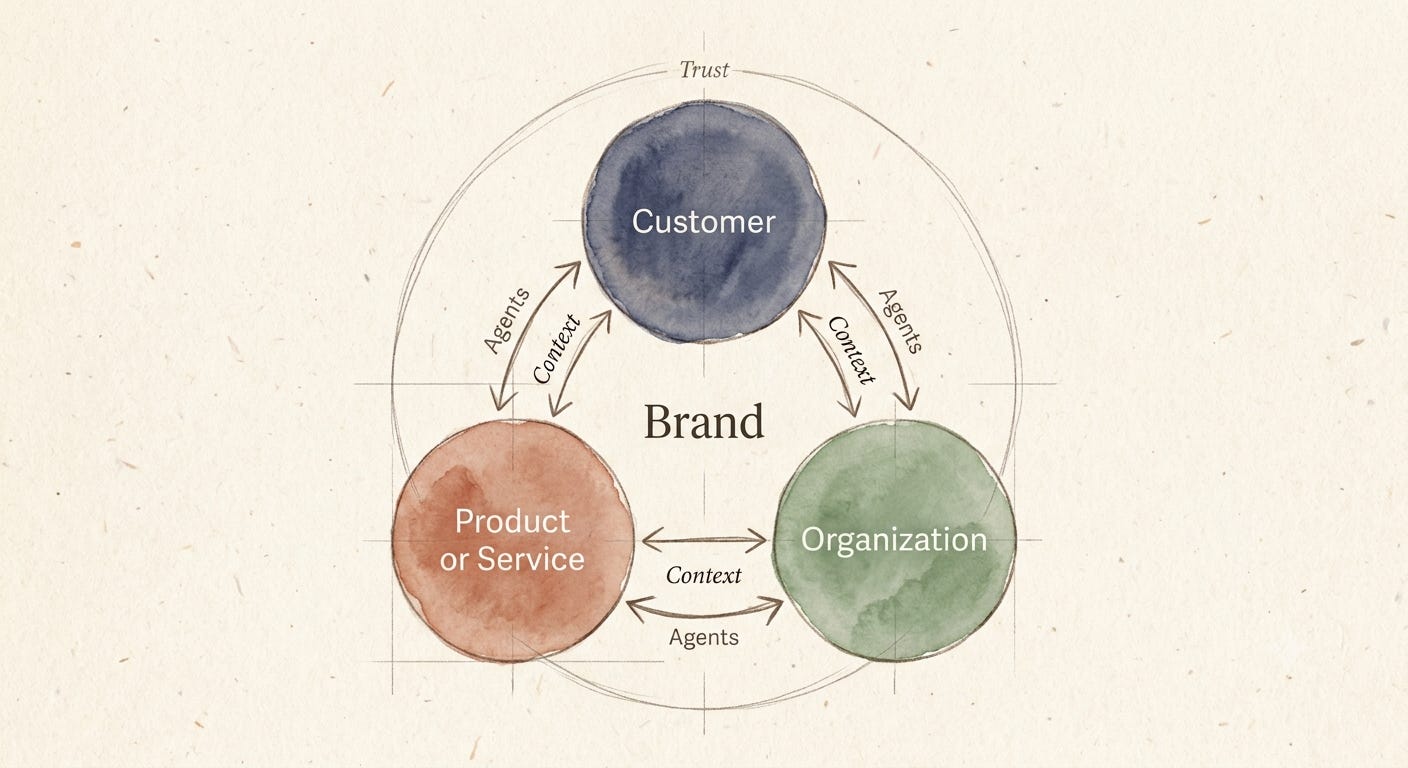
In the three-body model I have been developing across my last several posts, brand becomes something quite different. It becomes the signal layer running between the customer, the product, and the organization, and all three of them draw from it and contribute to it continuously.
Here is what that looks like. The customer’s agent will notice how the enterprise’s claims are landing over time. Which promises are holding. Which have been discounted as noise. Which are being cited approvingly to other agents. The product will have its own tuned intelligence, and it will contribute what it is learning about how it is actually being used and where it is falling short. The enterprise will bring what it has committed to, what it is deciding, and what it wants to become. All of that flows through the brand signal, and each body uses what the others contribute to figure out what to do next.
What sets brand apart from the other layers in this infrastructure is that it carries two very different kinds of value at the same time. There is the quantitative side, which is what agents will actually work with. Reputation over time, a running record of commitments made and kept, the specific claims that have been verified and the ones that have not. Then there is the qualitative side, which is what humans still experience directly. The meaning of the brand. Its character. Whether it feels like something you want to be associated with. These are not the same kind of thing, but brand is where they meet, and the enterprise cannot operate in the new era without both being present at once.
The enterprise will learn what its brand actually is from the signal itself, not from a focus group or a survey or its own guess about how customers feel. The customer’s agent will negotiate on the basis of what the signal shows about the current state of the relationship, not on the marketing narrative. The product will evolve in response to what the signal is telling it about what customers actually care about. Brand stops being a story the enterprise tells about itself and starts being something the whole relationship produces together.
This is the kind of co-creation the deflection era could not have generated. Brand does not disappear in the agentic era. It becomes part of the infrastructure. And the enterprises that learn to build for both sides of what it now carries, the machine-readable and the human-felt, will end up with a version of brand that a hundred years of marketing has been trying to describe without ever quite reaching.