

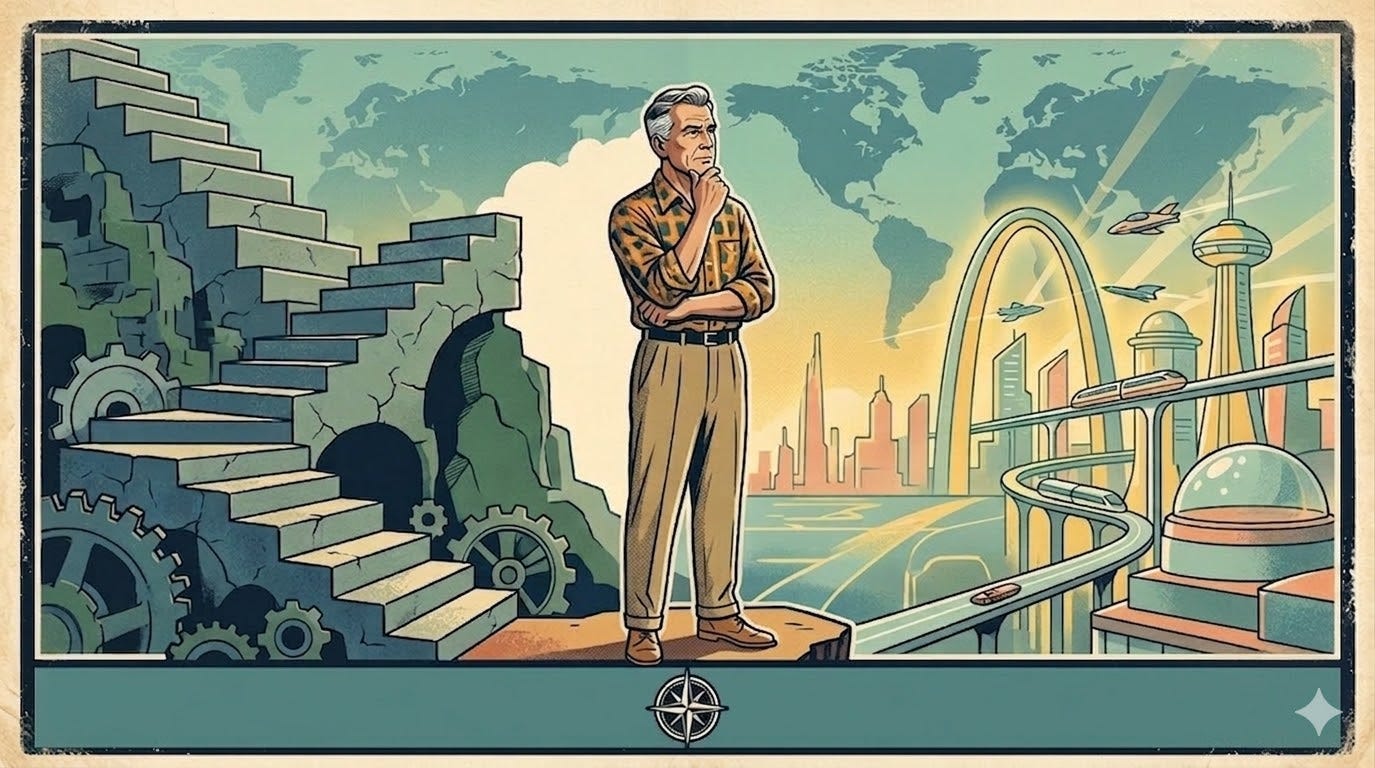
In the midst of all the AI hype, CX leaders are challenged to solve the same problem in two languages. The first language is quarterly: the board wants AI wins, velocity, cost reductions, and ROI to demonstrate to their shareholders. The second is structural, and it lands six months later when the same board asks why CSAT moved three points but revenue per agent didn’t, and why the P&L doesn’t reflect greener dashboards.
These languages aren’t contradictory, rather they’re sequential, and conflating them is what sits underneath every “AI is everywhere except in the bottom line” narrative that seems to be everywhere.
The Phase One Fixation
McKinsey’s recent piece on where AI will and won’t create value is, on a careful reading, a memo about timing. It names three waves: productivity gains, differentiation, and transaction-cost reduction. Most organizations are deep into the first wave and organizing as if it’s the only one that matters.
That’s the risk. McKinsey argues productivity gains rarely expand profit pools, because competition erodes them and customers capture most of the value (as it should be). Phase One is table stakes, not the prize. Real value comes later, when AI changes what you can offer customers and reshapes the economics of the markets you compete in. Treat Phase One as the destination and you’ll miss the transformation you think you’re executing.
Even Phase One Isn’t Compounding
The issue is that, in the real world, most organizations aren’t winning Phase One either. Goldman Sachs puts task-level savings around an hour a day, and Deloitte shows 66% of organizations reporting productivity gains while only 20% see revenue growth from them. As I wrote about previously, Amdahl’s Law, is in full swing with Phase One.
If AI accelerates 30% of a workflow, the improvement is capped by everything it doesn’t touch. Approval chains, handoffs, exception paths, and process structures built for constraints that no longer exist all stay in place, and speeding up part of a workflow that was never designed for speed just produces a faster version of the same output.
Stanford’s research puts numbers on this: companies that redesigned workflows around AI saw median productivity gains of 71%, while those that deployed the same AI without redesign saw 30%. The only variable was the redesign.
Beyond Phase One: Redesigning work
Stuart Winter-Tear’s recent Substack post has the cleanest framing for this angle. The moment AI touches live work, he writes, “it stops being ‘just software.’” It becomes behavior on the organization’s behalf, which means you’re changing how work moves, where judgment lives, and who absorbs the consequences when the workflow is wrong.
He names the unpriced cost as AI Translation Debt: the work of repairing meaning where work crosses teams, systems, vendors, or approvals. Humans used to absorb that debt invisibly, but AI doesn’t remove it. It collects it, amplifies it, and presents it back as “review.” That’s why CX teams feel busier rather than lighter after the first wave. The tools work, but the workflow was never redesigned to carry them.
Framing for the Next Phase
The CX leader’s job is to hold two horizons at once: short-term wins that prove value this quarter, and a redesign thesis that prepares the organization for the subsequent phases. Quick wins without a thesis don’t compound, and a thesis without quick wins doesn’t survive the budget cycle. There are essentially four moves to keep both clocks running in strategic alignment.
Pick workflows, not tasks. Choose end-to-end CX workflows where delegation could plausibly change unit economics: onboarding, escalation, retention. “Deflect this query” isn’t a workflow, it’s a task, and tasks alone don’t serve the long term time horizon.
Budget the intangibles. Stanford’s data is unambiguous: for every dollar of AI technology, organizations that achieve real productivity gains spend up to ten dollars on process redesign, reskilling, and change management. If your AI budget is mostly licenses, you’re underwriting a J-curve you won’t survive.
Make the seams visible before you scale. Where are humans currently filling in what the workflow doesn’t specify? Name it, price it, and decide whether that judgment stays human, gets delegated, or gets engineered out. Skip that step and Translation Debt scales invisibly, surfacing later as escalation load and margin leakage.
Anchor every quick win to a Phase Two thesis. Each deployment should answer one question: which moat is this building or eliminating? Proprietary data, workflow embedding that raises switching costs, faster learning cycles? A quick win that doesn’t compound into structural advantage is a productivity demo, not a strategy.
The CX leaders who define this era won’t be the ones who optimized hardest for Phase One, they’ll be the ones who used short-term wins to fund the longer redesign.
And what’s coming for CX aren’t faster sales, service, marketing departments, it’ll be the dissolution of the department line itself. For example, customer service and support were never genuinely a department, they were artifacts of a system that couldn’t route enterprise context fast enough to act otherwise. AI changes that constraint. The next phases of value will come from teams that step past “the job to be done” and design for the value to be provided to the customer, wherever in the enterprise that value lives.
More on this line of thinking next week.