

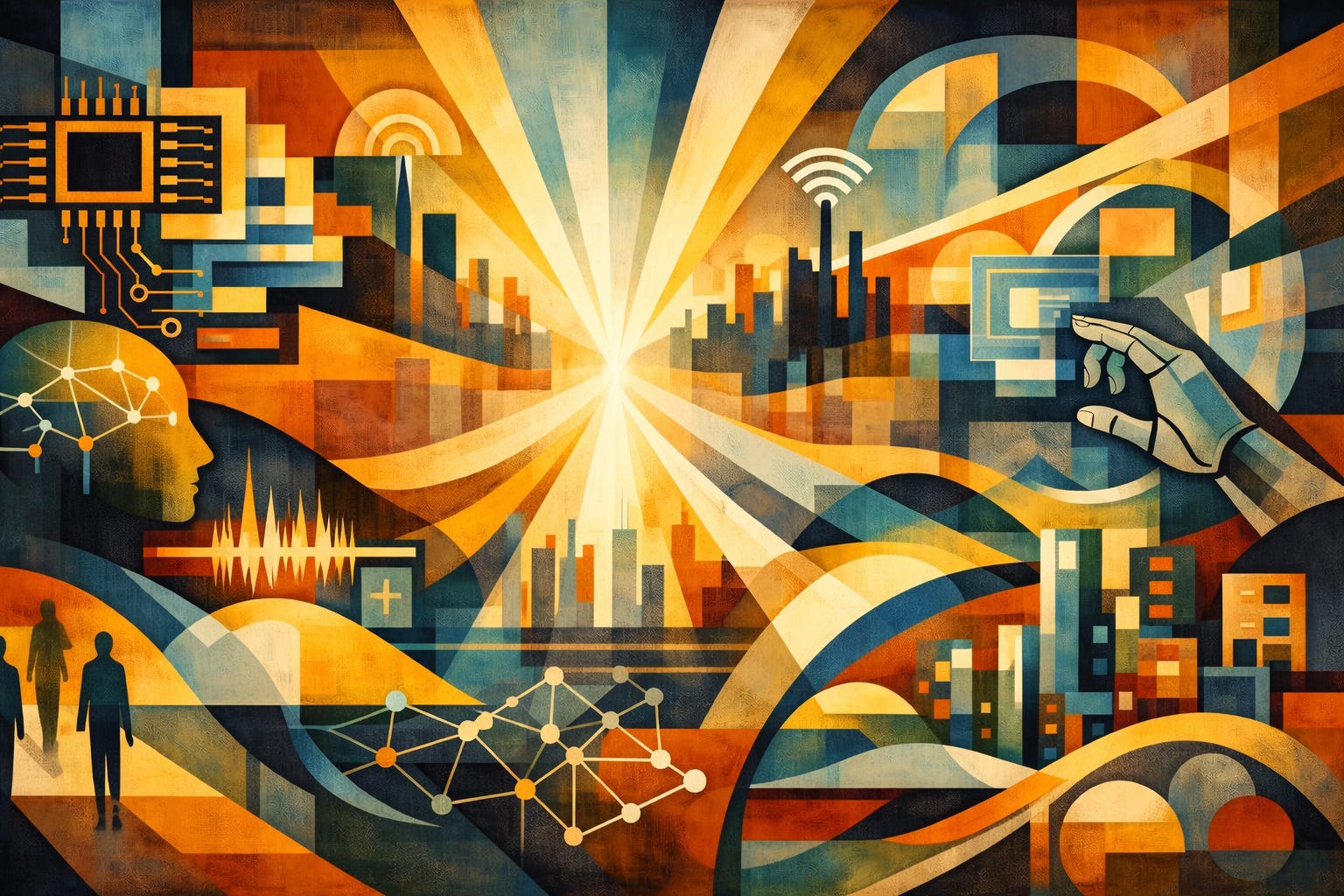
Back in June 2025, I started this Substack with a post about an emerging era that I labeled Future Intense. What I laid out was the idea that we were entering the Cambrian Era of Computing and CX. We are witnessing an unprecedented explosion of complexity and variety in the core components of computing, from silicon to the surface. As we enter 2026, the premise remains the same: The intensity of technological development is accelerating at breakneck speed, with next year shaping up to be one of profound change.
In chemistry, intensity often refers to a concentration of power or light in a specific area. In technology, we are entering a similar phase where the sheer density of intelligence, compute, and connectivity is reaching a critical mass. We aren’t just adding more features; we are compressing the distance between intent and execution, enabling decisioning at every layer, and altering our relationship with technology irreversibly.
Looking ahead to 2026, the landscape feels less like a series of scattered breakthroughs and more like a coherent, high-velocity movement. It’s shaping up to be an optimistic era where the plumbing of the digital world is being ripped out and replaced with something far more fluid. Here is how that intensity will likely reshape our world.
The Silicon Bedrock: Efficiency Over Raw Power
For years, the semiconductor narrative was a simple race for speed. In 2026, the narrative will shift toward contextual efficiency. For example, we are seeing the mainstreaming of 2nm manufacturing processes and the transition to a focus on lower power consumption (performance per watt) even as we demand more from our devices.
But the real future intense story in silicon isn’t just miniaturization; it’s heterogeneous integration. The one-size-fits-all processor is becoming a relic. Instead, we are seeing a world of chiplets, modular components that allow designers to mix and match specialized accelerators for AI, security, and networking on a single package.
This shift is powering Edge AI like never before. In the near future, your devices won’t just run AI; they will learn from you locally. This means on-device training becomes a standard feature. Your phone, your car, and even your smart home sensors will refine their models based on your specific habits without ever sending that data to a central cloud. It’s a win for privacy and a massive leap for latency, making our interactions with technology feel instantaneous rather than processed. This development will shift the dynamic for customer experience as well, as more decisions will take place on the edge, and require a reframing of the customer-to-enterprise relationship.
The Great Unwinding: From Stacks to Orchestration
For decades, the enterprise technology landscape was defined by the stack. You had your CRM, your ERP, and your foundational platforms, where each had distinct silos of data and logic. To get anything done, humans often had to act as the glue, manually moving data between these layers. Worse yet, when integrated, that integration often relied on codifying process flows which were relics of a bygone era.
In 2026, the unwinding of the enterprise software stack will become the emerging storyline for enterprise software. The traditional monolithic application is being hollowed out and what’s emerging in its place is a new orchestration layer.
Think of this as an Agentic Operating System. Instead of you logging into a CRM to update a lead, an AI agent, operating within this orchestration layer, will recognize a change in a customer’s sentiment via an email, check the supply chain for product availability, update the forecast in the ERP, and draft a related and contextualized outreach. This type of orchestration will lift embedded business logic from the static data architectures of enterprise software onto a dynamic run-time execution layer that will be highly contextualized and vary by instance.
Software is moving from a place you go to into a set of capabilities that work for you. This isn’t about replacing software; it’s about making it less visible. The orchestration layer will act as the conductor, ensuring that the fragmented tools of the past finally play the same symphony. We are moving from a world of apps to a world of actions.
Reimagined Interfaces: The World as a Surface
The iPhone was introduced nearly two decades ago, and ever since, we’ve assumed that the glowing rectangle in our pockets was the apex interface of the future. This is about to change, and it looks like 2026 will be a transitional year. We are about to see a revolution in human interfaces, where digital interaction is no longer confined to a screen.
This the rise of smart surfaces. Through advancements in computer vision, near-field communication (NFC), and acoustic sensors, the physical objects around us are becoming interactive. The interface is becoming spatial. In this near future, interacting with technology will feel less like using a tool and more like existing in an environment that is aware of your needs. We are moving away from looking at data and toward living with it.
AI’s True Calling: The Operator, Not the Assistant
Where will AI play the biggest role in this future intense era? It’s moving beyond the Copilot phase. While the early 2020s were about AI as a helpful assistant that could summarize a meeting or write a poem, 2026 is the era of the AI Operator.
The biggest impact will be seen in the most complex scenarios, ones that will have broad societal implications. Whether it’s optimizing a city’s power grid in real-time to account for renewable energy fluctuations or managing the hyper-complex logistics of a global just-in-case supply chain, AI will increasingly take the wheel on systems that are simply too fast and too data-dense for human cognition alone. This operator orchestration will require an entirely refreshed approach to administration, security, and risk management.
2026: An Optimistic Intensity
While the future intense isn’t a period to fear, it represents a concentration of human ingenuity designed to deepen the resonance of our lived experiences. By moving intelligence to the edge, unwinding clunky software into elegant orchestration, and turning the world itself into a responsive interface, we are finally making technology conform to the nuances of human intent, rather than forcing ourselves to speak the language of the machine. Along the way, we need to remain cognizant of the agency of humans, and the related boundaries of interaction.
As we move through 2026, the goal isn’t just to be more productive, but to be more present. When the intensity of technology will handle more of the mundane coordination of our lives, it will hopefully leave us with the most valuable resource of all: the agency to explore our potential and the time to be truly human.